
Summary
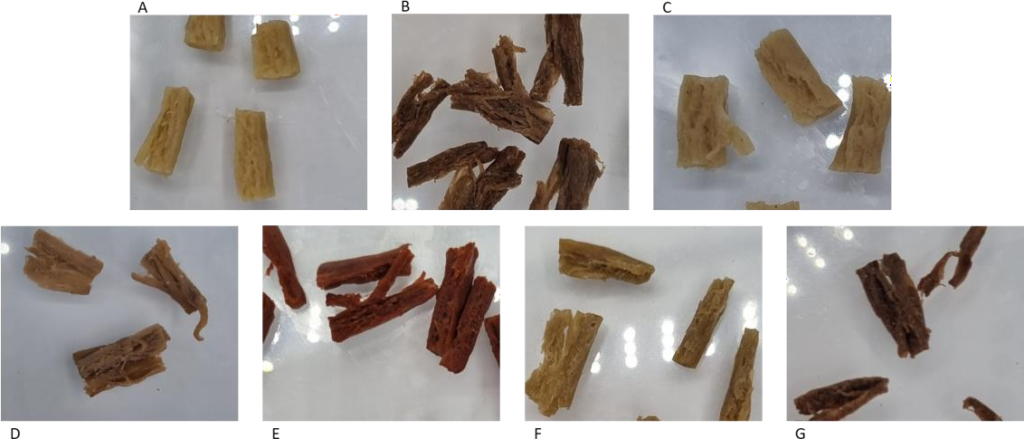
The project aimed to: i) establish a simultaneous aqueous extraction process for the protein and fat fractions of cupuaçu seed (processing residue); ii) optimize an anisotropic structure based on wheat gluten in a cold shearing process followed by cooking under sustained deformation; iii) incorporate the fractions extracted in objective i) and dehydrated açaí pulp (of interest to the community) into the matrix of objective ii), seeking to mimic meat in terms of texture and color.
Proposed solution
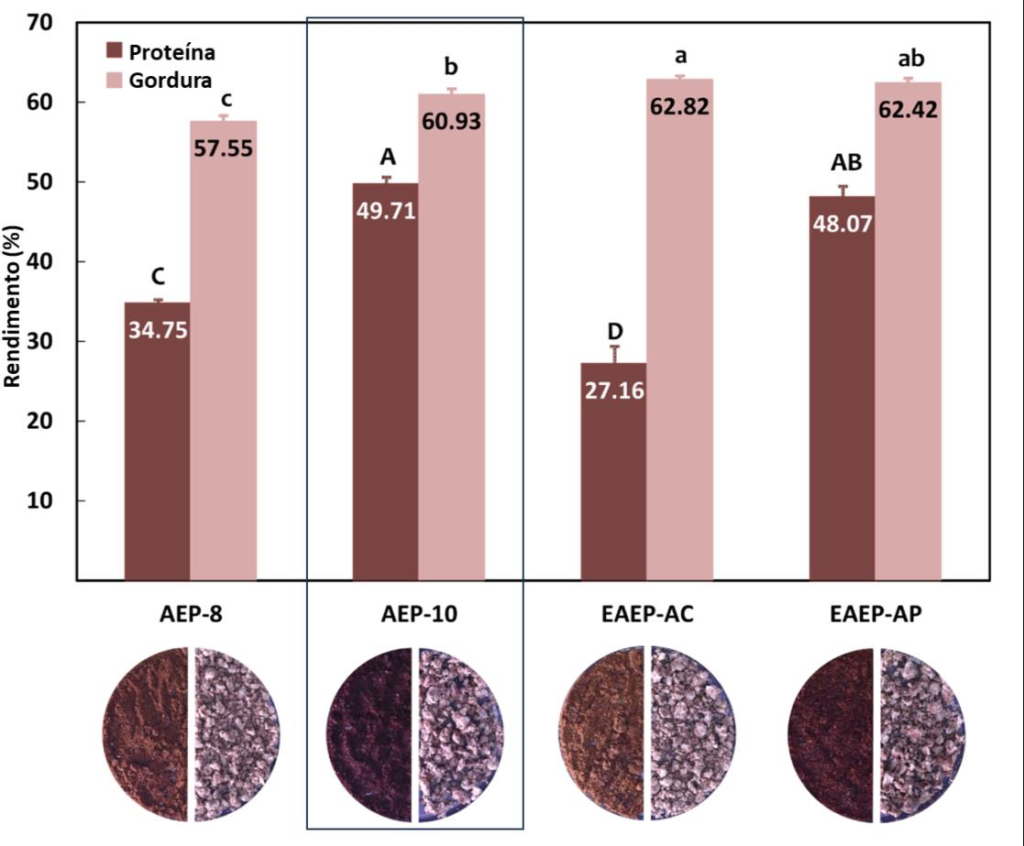
The extraction process successfully separated the protein and lipid fractions with good yields, eliminating the need for pressing or organic solvent extractions. The structuring provided non-extruded anisotropic matrices, consistent with the community's needs, and stable for incorporating Amazonian raw materials.
Technological advantage
The proposal allows for the production of anisotropic matrices without employing extrusion processes, as well as utilizing the cupuaçu seed (a fruit currently being processed by the community) through a simple and environmentally friendly extraction process capable of providing nutrients and pigments that can be incorporated into the matrices. Combined with the use of açaí pulp already processed in the community, this approach enables the planning of a regional product and strengthens the development of the sector in that locality.
Project TRL, maturity level
Simultaneous extraction: TRL 4-5, anisotropic structure TRL 2-3.
Images
Related publications
- Non-thermal shearing effect on gluten conformation for plant-based anisotropic structures. Available at: https://www.sciencedirect.com/science/article/pii/S1466856424002856?via%3Dihub
Authors and affiliation
UFSC
- Prof. Dr. Acácio Antonio Ferreira Zielinski
- Prof. Dr. João Borges Laurindo
- Dr. Laís Benvenutti
- Dr. Mariana Angonese
UCDavis
- Prof. Dr. Bruno Augusto Mattar Carciofi
UNIFESSPA
- Prof. Dr. Jhony Tiago Teleken
AgroParisTech
- Prof. Dr. Gabriela Zanghelini