
Summary
The project developed a plant-based meat from pequi fruit, using the pulp, kernel, and peel. The peel, which represents about 75% of the pequi, was processed to reduce the bitterness caused by tannins and transformed into a flour with a high fiber content: 65,1 g/100 g on a dry basis. The plant-based meat was used in plant-based burgers and croquettes and demonstrated potential to add value to parts of the fruit that are normally discarded and generate new opportunities for extractive communities.
Proposed solution
Transforming underutilized parts of the pequi fruit into a plant-based meat for burgers, croquettes, and other dishes. The peel is converted into a fiber-rich flour, with 65,1 g/100 g on a dry basis; the pulp and kernel add flavor, aroma, and lipids. This solution expands the use of the fruit and can generate new income opportunities for extractive communities.
Technological advantage
The main technological advantage is the utilization of parts of the pequi fruit that are normally discarded, especially the peel, which represents about 75% of the fruit and has been transformed into a fiber-rich flour. This flour showed relevant functional properties for vegetable formulations, such as gel formation from 8%, emulsifying activity of 50,3%, and emulsion stability of 98,3%. Pequi vegetable meat also functions as a versatile base for hamburgers, croquettes, and frozen ready meals, with formulations that use pulp, almond, cowpea, and textured soy protein.
Technology Maturity Level – TRL: 4 — Benchtop technology validation
Next Steps
Develop a line of frozen ready meals using the created meat analogue, conduct a financial feasibility study of the shell flour, move to pilot-scale testing, and seek partners for industrial scaling and commercialization.
Images
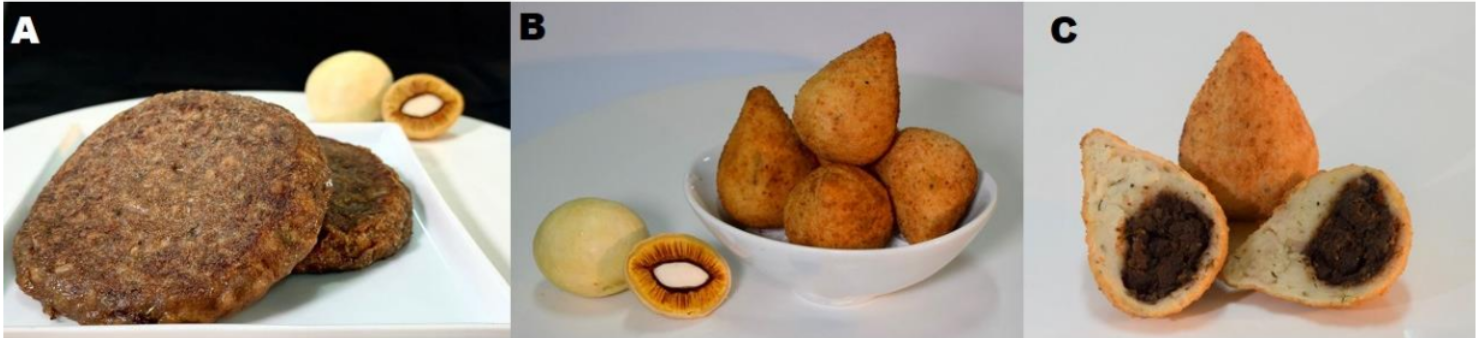
Related publications
- Meat analogue from pequi (Caryocar coriaceum Wittm.). Available at: https://www.infoteca.cnptia.embrapa.br/infoteca/handle/doc/1171270
Authors and affiliation
Dr. Ana Erbênia Pereira Mendes – Gastronomy Course at the Federal University of Ceará (UFC), in collaboration with Embrapa Tropical Agroindustry.
Team listed in the project handbook.
- Ana Erbênia Pereira Mendes
- Adriana Camurça Pontes Siqueira
- Eveline de Alencar Costa
- Paulo Henrique Machado de Sousa
- Diana Valesca Carvalho
- Alessandra Pinheiro de Góes Carneiro
- Matusaila Aragão Macedo
- Leopoldo Gondim Neto
- Maria do Socorro Rocha Bastos
- Roselayne Ferro Furtado
- Selene Daiha Benevides
- Antonio Calixto Lima
- Arthur Claudio Rodrigues de Souza
- Vinícius Quintino Lavor Andrade
- Samuel Rabelo Costa
- José Jurandi Alves Filho